Keto and low carb dairy: the best and the worst
 , medical review by Dr. Bret Scher, MD
 Evidence based
You see, on a low carb or keto diet, not all dairy products are equal. What’s more, responses to dairy can vary from person to person.
In this guide, we’ll let you know what’s potentially good and not so good about dairy, and help you make the best low carb choices.
Key takeaways:
- Responses to different dairy products are individual; some people do well eating large amounts, while others may be better off consuming little to no dairy.
- There are many great keto-friendly dairy options, such as cheese, whole-milk Greek yogurt, cream, and butter.
- Although you can probably include dairy on a low carb or keto lifestyle, you may want to consider limiting it to break a weight-loss stall or to improve acne or digestive issues.
Visual guide
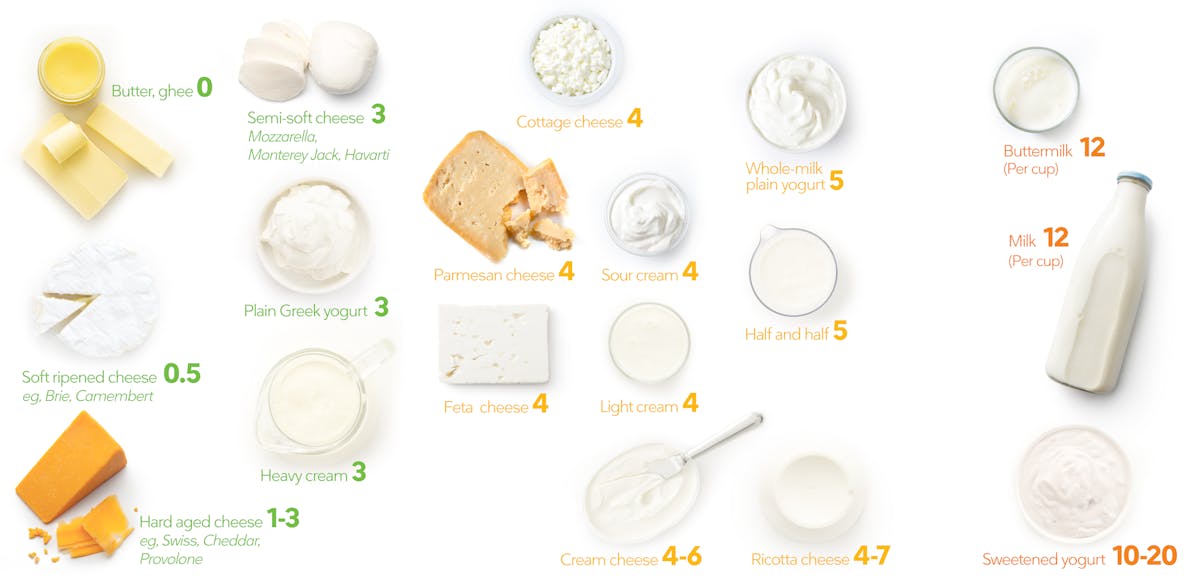
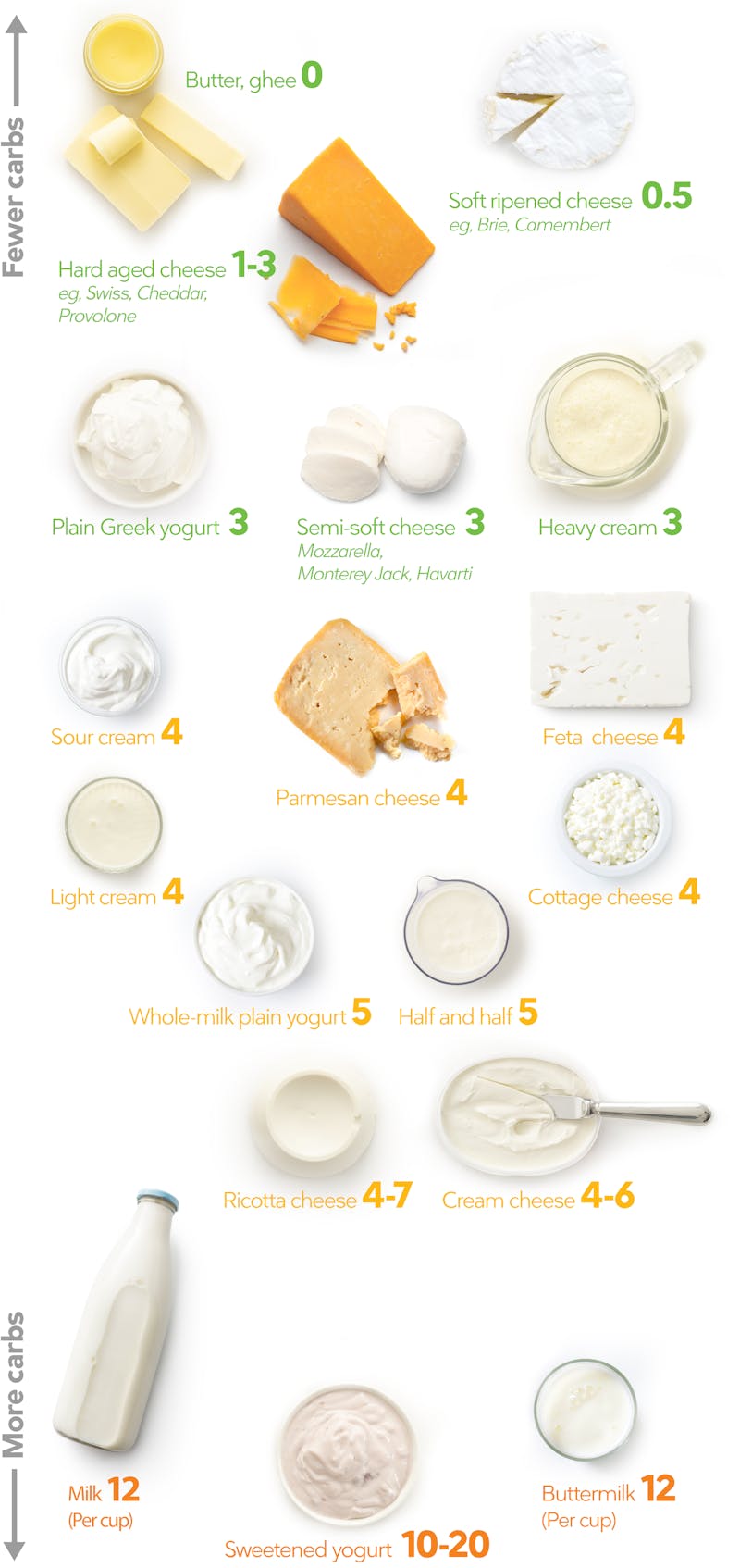
The graphic below shows how many carbs different dairy products contain. The numbers are per 100 grams (3.5 ounces) of each food, except where noted.12
What is dairy?
Dairy products are foods or beverages that are made from the milk of mammals. In the US and Europe, dairy from cows’ milk is far more commonly consumed than other types. However, in some cultures, goat and sheep dairy are also very popular.
Milk is a relatively nutritious food that contains protein, fat, and carbohydrates:
- Protein: The two main proteins in milk are casein and whey. About 80% of the protein in milk is casein and the remainder is whey.3
- Fat: Milk contains mostly saturated fats. Dairy fats are 70% saturated, 25% monounsaturated, 2.5% polyunsaturated, and 2.5% naturally occurring trans fats.45
- Carbs: Lactose (milk sugar) is the type of carb found in milk. In your digestive tract, it’s broken down into the single sugars galactose and glucose. Glucose then enters your bloodstream, raising blood sugar levels.6
Dairy products made from milk include cream, cheese, butter, and yogurt — and their carb counts differ quite a bit.
Carb counts of different dairy products
Why are some types of dairy high in carbs and others low? It depends how they’re processed and how much lactose remains afterwards.
In general, milk that has been fermented with bacteria is lower in carbs than non-fermented dairy.
The list below contains the number of net carbs per 100-gram (3.5-ounce) serving of different dairy products, unless otherwise noted.7
For example, when making cheese, milk is treated with bacteria that causes the lactose (sugar) to be fermented into lactic acid, thereby removing most of the carbs. Additionally, the liquid whey that results during processing — which contains protein, water, and lactose — is drained off, leaving mainly casein.8
Similarly, during yogurt production, milk is treated with different strains of bacteria that ferment most of the lactose into lactic acid. However, it has a few more carbs than most cheese because some lactose remains.9
The amount of carbs a yogurt contains is mainly influenced by the fermentation time. The longer it ferments, the more lactose is used up and the fewer carbs the end product has.
Here are the carb counts for some of the most common dairy products:
Lowest carb: (0-3 grams per 100 g/3.5 ounces)
- Butter and ghee: Butter is made from milk fat and contains only trace amounts of lactose (sugar) and whey (protein). Ghee, also known as clarified butter, has had all lactose and whey removed. Butter has only 0.1 gram of carb and 0.1 gram of protein per 100 grams. So, like ghee, it’s essentially carb-free.
- Soft-ripened cheese: Velvety brie, Camembert, and similar soft-ripened cheeses are among the lowest in carbs of all cheeses, with only 0.5 gram of carb per 100 grams.
- Hard (aged) cheese: Rich in flavor, hard cheeses like cheddar, Swiss, and provolone contain very little lactose. They’re extremely keto-friendly; most provide about 1 gram of carb per 100 grams, although some may contain up to 3 grams.
- Semisoft cheese: Midway between hard and soft cheese in texture, semisoft cheeses like mozzarella, Monterey Jack, and havarti are versatile and widely available in the US. They have slightly more carbs than most hard cheeses: about 2-3 grams per 100 grams. Veined blue cheeses like Gorgonzola and Stilton also belong to this category.
- Plain Greek yogurt: If you’re a yogurt lover, plain Greek yogurt is by far your best choice for low carb or keto eating. It has fewer carbs and is thicker than other yogurts because more of the liquid whey (which contains the milk sugar lactose) has been strained during processing. Although carb counts vary slightly among different brands, Greek yogurt has about 3 grams of carb per 100 grams (a little less than ½ cup) and 5 grams per 170-gram (¾ cup) container.10
- Heavy cream: Heavy cream is made by skimming the fat off the top of milk. Although it is much lower in carbs than milk, it’s not a zero carb food. Heavy cream contains about 3 grams of carbs per 100 grams (about 0.5 gram per tablespoon).
Middle carb: (4-7 grams per 100 g/3.5 ounces)
- Feta and Parmesan cheese: Even though they’re slightly higher in carbs than some other cheeses, feta and Parmesan can still be a good fit for a keto or low carb diet. Both contain about 4 grams of carb per 100 grams (about ⅔ to 1 cup), or slightly more than 1 gram of carb per ounce (30 grams).
- Light cream: Similar to heavy cream, but with a lower fat content, light cream provides 4 grams of carbs per 100 grams, or 0.5 gram per Tablespoon.
- Sour cream: Adding lactic acid bacteria to light cream results in pleasantly tart-flavored sour cream. It also thickens the end product without changing the carb content: 4 grams per 100 grams.
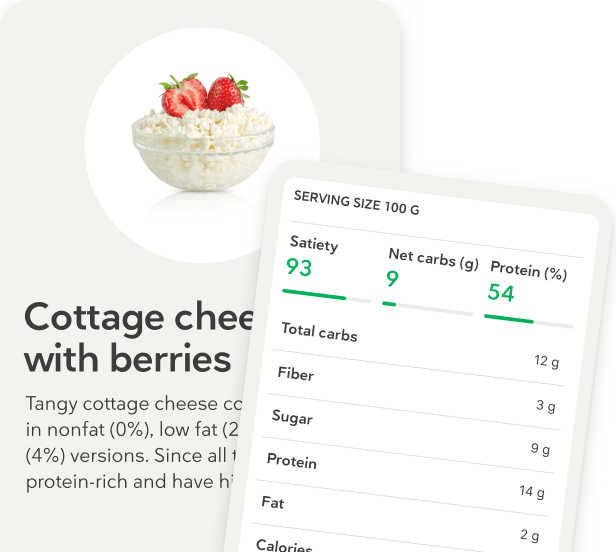
- Cottage cheese: Cottage cheese is made by adding acidic bacteria to milk, causing the casein to curdle and create curds that separate from the whey. These curds give cottage cheese its lumpy appearance. It contains about 4 grams of carb per 100 grams (approximately 1/2 cup).
- Half-and-half: Appropriately named, this popular creamer choice contains 50% milk and 50% cream. It provides about 5 grams of carb per 100 grams, or 0.6 gram per Tablespoon.
- Whole-milk plain yogurt: Like Greek yogurt, whole-milk plain yogurt is made with bacteria that ferment most of the lactose in milk into lactic acid. Because it isn’t strained, it retains a few more carbs than Greek yogurt does: about 5 grams per 100 grams, or 9 grams per 170-gram (¾ cup) container. Exact carb counts vary from brand to brand.
- Kefir: Similar to yogurt in taste, kefir is a thick beverage made by fermenting milk with a combination of bacteria and yeast. The carb content varies between 4 and 7 grams per 100 grams, depending how it is made.
- Ricotta cheese: Smooth, slightly sweet ricotta was traditionally made using the liquid whey left over from producing hard cheese. Today, it’s made from fresh whole milk and vinegar. Whole-milk ricotta contains about 4 to 7 grams of carbs per 100 grams (approximately ½ cup), although this can vary among different brands. Low fat types are typically higher in carbs.
- Cream cheese: Although its name might lead you to think it’s extremely low in carbs, cream cheese actually provides about 5-7 grams of carbs per 100 grams. It’s made by adding lactic acid bacteria to a combination of milk and cream and then heating the mixture, producing a rich, creamy texture. It can be a good choice on a keto diet when consumed in modest amounts.
Highest carb (12-25+ grams carbs per cup)
- Milk: Although the amounts of fat differ, carb counts are the same for all types of milk: whole milk, low fat, and nonfat (skim) milk: about 12 grams per cup (250 ml).
- Buttermilk: Despite its name, buttermilk is actually quite low in fat — and high in carbs. In fact, it contains the same 12 grams of carb per cup as other types of milk.
- Sweetened or fruit-flavored yogurt: Unsurprisingly, sweetened yogurts are very high in carbs: 20+ grams per 170-gram (¾ cup) container.
- Light yogurt: What about “light” or “lite” yogurt? Although they’re marketed to health-conscious consumers, many light yogurts contain added sugar. Be sure to read labels. Some brands of “light” yogurt contain 18 or more grams of carb per 170-gram (¾ cup) container.
What are the benefits of consuming dairy on a keto or low carb diet?
There are plenty of reasons to include dairy in a low carb lifestyle.
Many low carb dairy products are high in protein
Getting adequate protein is important for good health. Eating more protein — including dairy protein — can help you feel full and may slightly boost your metabolic rate, making it easier to achieve and maintain weight loss.11 In addition, higher protein and dairy diets show promise for helping lose fat mass while gaining lean muscle.12
Most hard and soft cheeses are good options for protein, containing about 6 to 8 grams of protein per ounce (30 grams), or 18 to 25 grams per 100 grams.
Which cheese is highest in protein? That honor goes to Parmesan, which packs an impressive 35 grams of protein per 100 grams of cheese.
Greek yogurt is also fairly high in protein, with many brands providing 15 to 18 grams of protein per 175-gram (¾ cup) container.
Dairy provides important vitamins and minerals
Cheese and yogurt are rich in several key nutrients, including vitamin A, vitamin K2, vitamins B6 and B12, and zinc.
Dairy products have a reputation for being an excellent source of calcium, although some types have more than others. Getting adequate calcium via dairy products has been shown to reduce the risk of bone fractures.13
Hard cheeses contain the most calcium, with Parmesan providing about 1,000 mg and Swiss and cheddar following closely behind with 720 to 790 mg per 100 grams, respectively.14
Yet all types of cheese and yogurt still provide decent amounts of this important mineral. So choose whichever dairy products you prefer to eat. You can also get calcium from non-dairy foods.15
Dairy consumption has been linked to good health
For the past several decades, we’ve been advised to limit our intake of butter, cream, and cheese because they contain a lot of saturated fat, which was thought to increase heart disease risk.
Yet according to most of the research to date, this recommendation appears to have been largely unwarranted.16
In fact, high-fat fermented dairy products like cheese and yogurt seem to have neutral effects on heart health and may possibly even decrease heart disease risk.17
Full-fat dairy products also provide conjugated linoleic acid, a naturally occurring trans fat that early research suggests can improve cardiovascular risk markers.18 However, more studies are needed to confirm this positive association.
Finally, a 2017 systematic review of 52 clinical trials concluded that consuming dairy products may help lower inflammatory markers in people with metabolic diseases, such as diabetes and obesity.19 A similar 2020 review found that dairy products had neutral to beneficial effects on inflammatory markers in healthy people and those with metabolic disease.20
Dairy is tasty and filling
There’s no denying that many dairy foods are delicious, and they can even help other foods taste better. For example, topping vegetables or lean steak with butter or a cream sauce can make a world of difference to the palatability and flavor of your meal.
As Dr. Bret Scher, Diet Doctor’s Medical Director, likes to say, “Anyone who doesn’t like broccoli or spinach, in my opinion, likely hasn’t had them properly cooked in butter and sprinkled with real salt!”
In addition to being flavorful, cheese can also be very filling. In one randomized controlled trial (RCT), cheese was found to reduce hunger and trigger the release of “fullness hormones” more than cream or whipped cream.21
Interestingly, a 2017 systematic review of 13 RCTs in adults found that although all types of dairy products seemed to increase feelings of fullness and decrease hunger, this didn’t lead to reduced intake at meals later in the day.22 However, these studies were conducted in people consuming high carb diets.
Unfortunately, at this time no studies have tested a dairy-containing low carb diet against a dairy-free one.
What are the potential drawbacks to eating dairy on a low carb or keto diet?
Some dairy products can raise insulin levels
Of the three macronutrients — protein, carbs, and fat — carbs have been shown to raise blood sugar levels the most, by far.23 And when blood sugar goes up, it triggers your pancreas to release insulin.
Since lactose (milk sugar) breaks down to glucose during digestion, consuming high-lactose dairy products can raise both blood sugar and insulin levels.
So if your goals include keeping insulin levels low, it’s likely best to steer clear of milk, flavored yogurt, and other types of high-lactose dairy.
However, even some keto-friendly dairy foods, such as cheese, also raise insulin levels somewhat. In this case, it’s not the carbs but the protein — or more specifically, amino acids — that cause insulin to rise.
Why does this happen? During digestion, protein is broken down into individual amino acids, which are absorbed into your bloodstream. This prompts your pancreas to release insulin, which helps the amino acids get into your muscles.
In fact, this happens with all protein foods, although to a greater extent with some than others. For instance, hard cheese raises insulin more than eggs but less than fish and beef. Yet all four of these protein foods raise insulin far less than carb-containing foods.24
Additionally, the whey protein in dairy is absorbed more rapidly than the casein.25 Therefore, consuming whey-containing dairy products may raise blood insulin levels more quickly than fermented dairy products that no longer contain whey.26
What about butter and cream? Because they have very little protein, they have minimal to no effect on insulin levels.
One thing to keep in mind, however, is that small, temporary increases in insulin after protein-containing meals likely don’t have the same negative health implications as chronically elevated insulin levels.27
Dairy may cause cravings
Although dairy is often considered filling, some people find that eating it causes cravings for more.28 One piece of cheese leads to another, then another. For some, it may seem almost impossible to stop eating.
This doesn’t happen in everyone, or likely even in most people. And there isn’t much high-quality research on the topic.
Still, there is some debate about whether dairy has addiction tendencies.29
While the science is inconclusive, clinical experience shows that, for some, dairy may trigger a desire to keep eating more and effectively bypass hunger cues.30
Too much dairy may cause weight-loss stalls31
Cheese, cream, and whole-milk yogurt are very tasty. Unfortunately, the flip side of being so delicious is that they can be very easy to over consume.
Yes, these foods are generally a good fit for a low carb or keto lifestyle. But eating too much of them may potentially cause a weight-loss stall — whether from too many calories, too many carbs, or a combination of both.
Some low carb clinicians advise their patients to consume these foods in moderation. For example, in his “No sugar, no starch diet” Dr. Eric Westman recommends limiting cream of all types to less than 2 tablespoons per day and cheese of all types to less than 4 ounces (116 grams) per day. These are still pretty generous amounts.
For some people, further limiting dairy, or even cutting it out altogether, may be helpful if weight loss slows down or stalls.
Dairy may worsen acne and other skin issues
Can dairy cause or worsen acne? In some people, it might. Dairy has been shown to raise levels of insulin-like growth factor 1 (IGF-1), a hormone that increases sebum production and has been found to play a large role in acne.32
Observational studies in children, teens, and young adults suggest that all types of dairy, including cheese and yogurt, may be problematic for those who struggle with acne.33
Read our complete guide, Can keto or low carb diets improve acne?
Some people may be sensitive to dairy
In certain individuals, dairy may cause digestive issues or other symptoms.
The most common dairy-related issue is lactose intolerance, which occurs in people who lack the enzyme lactase.
Without this enzyme, lactose can’t be properly digested and absorbed. Instead, it passes into the colon, causing abdominal pain, bloating, gas, nausea and/or loose stools.
Lactose intolerance is quite common. It’s believed to affect up to two-thirds of people worldwide. However, it’s considerably less common in people of European ancestry.34
People who are lactose intolerant can usually tolerate low-lactose dairy products like cheese or yogurt with little to no issues, although some may be sensitive to even the small amounts of lactose in these foods.
Sometimes people develop an allergy to one or more of the proteins in milk. Although somewhat common in children, true cow’s milk allergy is rare in adults.35 Those with milk allergies can experience symptoms such as hives, digestive upset, vomiting, and even anaphylaxis after consuming dairy.
There’s some evidence that certain individuals may be sensitive to A1 beta casein, the most common type of protein found in cows’ milk, which can lead to digestive symptoms similar to those of lactose intolerance.36
Sheep and goat dairy, as well as dairy from cows that produce A2 beta casein milk, may be easier for people with an A1 beta casein sensitivity to digest. However, this topic requires further study.
Should you eat dairy on a keto or low carb diet?
As is the case with many foods, response to dairy is highly individual.
Most people can include cheese, butter, Greek yogurt, and other low carb dairy products on a keto diet without any issues. And there are a wide variety of keto-friendly dairy foods to savor and enjoy.
If you have a milk allergy, which is rare among adults, you should obviously avoid dairy products.
If you’re lactose intolerant, you may be able to enjoy small amounts of cheese, butter, and other low-lactose dairy products. However, if you react to even tiny amounts of lactose, steering clear of dairy altogether may make sense.
A dairy-free trial may also be a good idea if you find that dairy triggers cravings, is difficult to eat in moderation, or seems to cause skin breakouts or other symptoms. Give it about three to four weeks, as it may take some time to notice any improvement.
During your break from dairy, you can enjoy coconut cream or almond cream in coffee or tea. Diet Doctor also has several delicious dairy-free recipes and dairy-free meal plans.(Not a member? Sign up for a 7-day trial to try our meal plans and get access to other great member content.)
If you’ve experienced a weight-loss stall but don’t want to completely eliminate dairy, try limiting yourself to a couple of tablespoons of cream and a couple of ounces of cheese per day.
With a little experimenting, you’ll soon figure out which types and amounts of dairy are the best fit for your own keto or low carb lifestyle.
Visual low carb guides



Recipe collections


Guides


Keto and low carb dairy: the best and the worst - the evidence
This guide is written by Franziska Spritzler, RD, Dr. Bret Scher, MD and was last updated on July 29, 2026. It was medically reviewed by Dr. Bret Scher, MD on September 23, 2022.
The guide contains scientific references. You can find these in the notes throughout the text, and click the links to read the peer-reviewed scientific papers. When appropriate we include a grading of the strength of the evidence, with a link to our policy on this. Our evidence-based guides are updated at least once per year to reflect and reference the latest science on the topic.
All our evidence-based health guides are written or reviewed by medical doctors who are experts on the topic. To stay unbiased we show no ads, sell no physical products, and take no money from the industry. We're fully funded by the people, via an optional membership. Most information at Diet Doctor is free forever.
Read more about our policies and work with evidence-based guides, nutritional controversies, our editorial team, and our medical review board.
Should you find any inaccuracy in this guide, please email andreas@dietdoctor.com.
The carbohydrate content information is from FoodData Central, the USDA’s nutrition database. The carb counts listed on packages of cheese, containers of yogurt, and other dairy products may vary slightly due to rounding and differences in processing. ↩
We provide the carb counts for one cup (250 ml) of milk because this is a typical serving size. 100 grams (100 ml) of milk contains about 5 grams of carbs; however, this is less than half a cup of milk. By contrast, typical portions of cheese, cream, and other dairy products are usually 100 grams or less. ↩
Iranian Journal of Pharmaceutical Research 2016: Health-related aspects of milk proteins [overview article; ungraded] ↩
Food and Nutrition Research 2008: Fatty acids in bovine milk fat [overview article; ungraded] ↩
Importantly, ruminant trans fats (which naturally occur in meat and dairy) don’t appear to have the same negative effects as industrial (man-made) trans fats like partially hydrogenated oils:Critical reviews in food science and nutrition 2016: Evaluation of the impact of ruminant trans fatty acids on human health: Important aspects to consider [overview article; ungraded] ↩
Metabolism 1993: Effects of glucose, galactose, and lactose ingestion on the plasma glucose and insulin response in persons with non-insulin-dependent diabetes mellitus [non-controlled trial; weak evidence] ↩
Net carbs = total carbs minus fiber ↩
The Journal of Nutrition 2004: Manufacture and use of dairy protein fractions [overview article; ungraded] ↩
The Journal of Dairy Science 2017: A 100-year review: Yogurt and other cultured dairy products [overview article; ungraded] ↩
Skyr from Iceland, Lebneh from the Middle East, and other strained yogurts have texture and carb counts that are similar to Greek yogurt. ↩
Journal of the American College of Nutrition 2004: The effects of high protein diets on thermogenesis, satiety and weight loss: a critical review [systematic review of randomized trials; strong evidence]
Nestlé Nutrition workshop series. Paediatric programme 2011: Milk proteins in the regulation of body weight, satiety, food intake and glycemia [overview article; ungraded] ↩
Journal of Nutrition 2011: Increased consumption of dairy foods and protein during diet- and exercise-induced weight loss promotes fat mass loss and lean mass gain in overweight and obese premenopausal women [randomized trial; moderate evidence] ↩
In a two-year randomized trial of more than 7,000 older adults living in residential care centers, those who consumed extra milk, yogurt, and cheese decreased their risk of all fractures by 33% and hip fractures by 46%:
The British Medical Journal 2021: Effect of dietary sources of calcium and protein on hip fractures and falls in older adults in residential care: cluster randomised controlled trial [randomized trial; moderate evidence] ↩
The RDA for calcium is 1,000 mg for most adults and 1,200 for postmenopausal women. ↩
Non-dairy food sources of calcium include sardines and canned salmon (especially if you eat the bones), almonds, seeds, broccoli, and leafy greens. ↩
Although still considered controversial among some experts, several large systematic reviews haven’t found any strong evidence linking high saturated fat intake to heart disease, early death, or other health problems:
Advances in Nutrition 2016: Systematic review of the association between dairy product consumption and risk of cardiovascular-related clinical outcomes [nutritional epidemiology study; very weak evidence]
British Medical Journal 2015: Intake of saturated and trans unsaturated fatty acids and risk of all cause mortality, cardiovascular disease, and type 2 diabetes: systematic review and meta-analysis of observational studies [observational studies; weak evidence]
And the following showed no significant benefit with calculations of replacing saturated fats with polyunsaturated fats:
British Medical Journal 2016: Re-evaluation of the traditional diet-heart hypothesis: analysis of recovered data from Minnesota Coronary Experiment (1968-73) [systematic review of randomized trials; strong evidence]
Nutrition Journal 2017: The effect of replacing saturated fat with mostly n-6 polyunsaturated fat on coronary heart disease; a meta-analysis of randomized controlled trials [strong evidence] ↩
In one study, overweight women experienced a 5% increase in HDL cholesterol without an increase in LDL after eating a high-cheese diet for just two weeks:
The American Journal of Clinical Nutrition 2015: Diets with high-fat cheese, high-fat meat, or carbohydrate on cardiovascular risk markers in overweight postmenopausal women: a randomized crossover trial [randomized trial; moderate evidence]
The PURE trial, a large observational study, showed dairy intake correlated with improved cardiovascular health, although this was an observational association and not necessarily a causative effect.
Lancet 2018: Association of dairy intake with cardiovascular disease and mortality in 21 countries from five continents (PURE): a prospective cohort study [anecdotal report; very weak evidence]
Two reviews of the evidence to date suggest that high-fat dairy may help protect, rather than harm, heart health:
Foods 2020: Dairy fat and cardiovascular health [overview article; ungraded]
Advances in Nutrition 2019: Effects of full-fat and fermented dairy products on cardiometabolic disease: Food is more than the sum of its parts [overview article; ungraded]
And in a 2021 systematic review of 18 observational studies, higher intake of dairy fat was associated with slightly lower heart disease risk:
PLoS Med 2021:Biomarkers of dairy fat intake, incident cardiovascular disease, and all-cause mortality: A cohort study, systematic review, and meta-analysis [systematic review of observational studies; weak evidence] ↩
Most of the human data in support of this comes from evidence showing improved surrogate markers such as increased HDL, decreased triglycerides and VLDL, and improved inflammatory markers.
British Journal of Clinical Pharmacology 2017: Atheroprotective effects of conjugated linoleic acid [overview article; ungraded] ↩
Of note, the following study showed increased inflammation in those allergic to bovine milk, but a decrease in inflammation in just about all others:
Critical Reviews in Food Science and Nutrition 2017: Dairy products and inflammation: A review of the clinical evidence [systematic review of randomized trials; strong evidence] ↩
Of 19 trials evaluating dairy, 10 reported no effect on inflammatory markers, while 8 reported a reduction in at least one inflammatory marker:
Journal of the American College of Nutrition 2020: The effects of dairy product and dairy protein intake on inflammation: a systematic review of the literature [systematic review of randomized trials; strong evidence] ↩
Journal of Dairy Science 2020: Dairy products influence gut hormone secretion and appetite differently: A randomized controlled crossover trial [moderate evidence] ↩
Clinical Nutrition 2017: Dairy products, satiety and food intake: A meta-analysis of clinical trials [systematic review of randomized trials; strong evidence] ↩
Diabetes Care 2004: Dietary carbohydrate (amount and type) in the prevention and management of diabetes [overview article; ungraded] ↩
The American Journal of Clinical Nutrition 1997: An insulin index of foods: The insulin demand generated by 1000-kJ portions of common foods [comparative study; weak evidence] ↩
Proceedings of the National Academy of Sciences of the United States of America 1997: Slow and fast dietary proteins differently modulate postprandial protein accretion [non-controlled trial; weak evidence] ↩
This was shown in a 2004 study comparing different dairy products, including milk, cheese, and pure whey protein:
The American Journal of Clinical Nutrition 2004: Glycemia and insulinemia in healthy subjects after lactose-equivalent meals of milk and other food proteins: the role of plasma amino acids and incretins [non-randomized study; weak evidence] ↩
This is based on clinical experience of low carb practitioners and was unanimously agreed upon by our low carb expert panel. You can learn more about our panel here [weak evidence]. ↩
This is based on clinical experience of low carb practitioners and was unanimously agreed upon by our low carb expert panel. You can learn more about our panel here [weak evidence]. ↩
Biopolymers 1997: Milk protein-derived opioid receptor ligands [overview article; ungraded]
Journal of Dairy Science 1994: An assessment of the addiction potential of the opioid associated with milk [overview article; ungraded] ↩
This is based on clinical experience of low carb practitioners and was unanimously agreed upon by our low carb expert panel. You can learn more about our panel here [weak evidence] ↩
This is based on clinical experience of low carb practitioners and was unanimously agreed upon by our low carb expert panel. You can learn more about our panel here [weak evidence]. ↩
Clinical, Cosmetic and Investigational Dermatology 2015: Linking diet to acne metabolomics, inflammation, and comedogenesis: an update [overview article; ungraded]
Nestlé Nutrition workshop series. Paediatric programme 2011: Evidence for acne-promoting effects of milk and other insulinotropic dairy products [overview article; ungraded] ↩
Journal of the European Academy of Dermatology and Venereology 2016: The constellation of dietary factors in adolescent acne: a semantic connectivity map approach [case-control study; very weak evidence]
Nutrients 2018: Dairy Intake and acne vulgaris: a systematic review and meta-analysis of 78,529 children, adolescents, and young adults [systematic review of observational studies; very weak evidence] ↩
There’s a wide variation in lactose intolerance among different geographic areas. It’s been shown to be least common in Europe and most common in the Middle East:
The Lancet Gastroenterology and Hepatology 2017: Country, regional, and global estimates for lactose malabsorption in adults: a systematic review and meta-analysis [meta-analysis of observational studies, weak evidence]
↩The percentage of adults with dairy allergy is estimated to be between 0.5-1.9% in the US, based on self-reported data:
Nutrients May 2019: Epidemiology of cow’s milk allergy [overview article; ungraded] ↩
In studies, people who believed they were lactose intolerant experienced far fewer digestive symptoms after consuming A2 beta casein compared to A1 beta casein milk:
Nutrition Journal 2016: Effects of milk containing only A2 beta casein versus milk containing both A1 and A2 beta casein proteins on gastrointestinal physiology, symptoms of discomfort, and cognitive behavior of people with self-reported intolerance to traditional cows’ milk [randomized trial; moderate evidence]Nutrition Journal 2017: Effects of cow’s milk beta-casein variants on symptoms of milk intolerance in Chinese adults: a multicentre, randomised controlled study [moderate evidence]
European Journal of Clinical Nutrition 2014: Comparative effects of A1 versus A2 beta-casein on gastrointestinal measures: A blinded randomised cross-over pilot study [moderate evidence] ↩