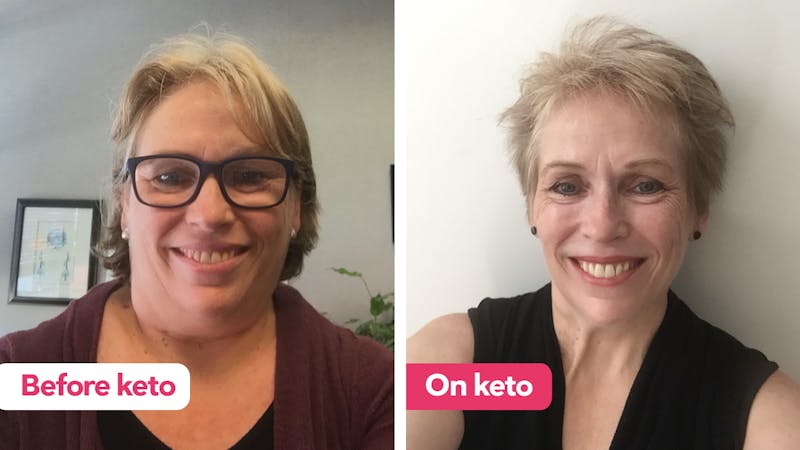
Meet Elizabeth, a 57-year old from Canada, who, after starting a keto diet, became symptom-free of a rare genetic disease that plagued her all her life.
Before starting keto, the disease, known as myoclonic epilepsy with ragged red fiber (MERRF), mostly presented itself as large lumps on Elizabeth’s body. In addition to this, Elizabeth experienced debilitating fatigue, weight gain, and pre-diabetes.
Today, Elizabeth weighs 51 pounds (23 kilos) less, feels fantastic, and she says, “All biomarkers indicate I’m in the best health of my life.”
Here, Elizabeth shares her full story, which has been lightly edited for length and clarity.
My name is Elizabeth, age 57. I live in Vancouver, British Columbia, Canada.
My older brother, who lives in the UK, was trying the keto diet to treat his glioblastoma, an aggressive form of cancer. Unfortunately, he passed away two years ago. Knowing I was struggling with health issues, he referred me to Diet Doctor.
I have a very rare condition called MERRF, myoclonic epilepsy with ragged red fiber. It’s a mitochondrial disease with no therapy or cure.
In November 1997, my first child tragically died from complications of this condition. Everyone in my large extended family has the same diagnosis, but it presents differently and to different degrees.
In March 2017, I was also diagnosed with pre-diabetes, and I also take medication for hypothyroidism.
My diet was the Standard American Diet (SAD), focusing on whole grains and modest amounts of lean meat. I was moderately active, a social drinker, and a non-smoker.
I had had surgery to remove a 7-pound (3-kilogram) lipoma from my upper back and suffered a metabolic crisis. I was placed on long-term disability and was told by my medical team that I had a “progressive disease for which there was no cure or therapy.”
The medical professionals that I saw told me to wait and see what happened. I waited six months and continued to gain weight due to debilitating fatigue, and my remaining lipomas continued to grow at an alarming rate. I was further diagnosed with pre-diabetes.
The standard of care was not working for me, and I felt I had no choice but to look at alternatives outside the standard of care.
I used the keto diet to drop weight, and I lost over 51 pounds (23 kilos) in six months. After three months on the diet, I began exercising and added in time-restricted eating.
I researched all these interventions using apps and was monitored carefully by my medical team. After six months and many blood panels and MRIs, my specialist told me my body was healing itself. I returned to work after 18 months on disability and continue to enjoy good health, some three years later.
I eat whole foods and avoid processed foods and oils. I generally eat one meal a day around noon, but my eating window is quite flexible based on my social or work schedule. I eat to satiety with an emphasis on protein as I’m an older female who lifts weights. Every three months, I do a five-day (120-hour) water fast.
Absolutely. I underestimated my need for supplements and hydration but have learned over time to manage both better. It’s challenging to find reliable guidelines as healthcare guidelines are based on the SAD.
Exercise was not necessary for me at the beginning of my journey. It came to be essential as I progressed and was one of the most effective epigenetic levers that I used to improve my mitochondrial function. I work with my local university and with a professional kinesiologist in planning my exercise program. I could not lift a cup of tea at my worst. Now I can deadlift 110% of my body weight.
My medical team and I have published an article in the Mitochondrion Journal and we are still in the embargo period (ends March 2021) I maintain an educational website for patients at theeducatedpatient.ca and my Twitter account is @ElizabethNade11.
Congrats on your amazing success Elizabeth! Your journey is an inspiration to everyone who has been told “there is nothing we can do.” Improving nutrition and lifestyle is always an option for regaining health. You are a shining example of that. Keep up the great work! Best, / Dr. Bret Scher
Check out our most popular success stories below, or view all stories we’ve ever published here.
Want to share YOUR success story with Diet Doctor? Visit our success story submissions page to get started.
 , medical review by Dr. Bret Scher, MD
 in Diabetes stories, Success story, Thyroid problems